
6/22/2025
Kids, sometimes ugly food is delicious food. Today, I attempted to make rice noodles by Clarissa Wei’s Made in Taiwan book. Honestly, I don’t recall eating this in Hong Kong. But, I picked this recipe because I wanted to understand how things work. Like I told your Uncle Croquette yesterday, Daddy was blessed to eat a wonderful amount of delicious food and delicacies while growing up. So, as a result, Daddy isn’t impressed by food very easily now. The food may still taste good, but most likely it won’t be stored in my long-term memory. So, Daddy is on his journey to better understand food and cooking instead. I want to appreciate the food, the techniques used to prepare it, and the effort put into it.
What I learned today is that I enjoy making new things with someone. If I am unsure of how something should be looking, then I enjoy brainstorming with someone like Mommy to confirm if I am on the right path. Most of the time, we both don’t know how it should look. However, two brains are still better than one, and we can hypothesize and choose a path forward.
Ingredients
- 2 cups of Thai rice flour, Clarissa suggested the Erawan (which means elephant in Thai) brand.
- 1/4 teaspoon of fine sea salt
- 1.5 cups of water
- Some canola oil (Fun fact: it is actually a modified version of rapeseed oil that Canada renamed Can – ola oil.)
Preparation
- Mix the rice flour, salt, and water in a large bowl. Whisk it until all of the flour is mixed in smoothly. Rest for at least an hour at room temperature. Clarissa said that you can do it overnight in the fridge. But, honestly, who has the fridge space? I bet you that she is a magician.
- Make sure you have a clean cutting board.
- So, after an hour or so, whisk the rice mixture to a smooth state again. Here is the fun part. Pour it into a non-stick pan and use a rubber spatula to stir it. I learned from Mommy that using a rubber spatula helps get sticky things out of containers more easily. Constantly stir for about 4 minutes. Some glop of flour will start sticking to the spatula. Slowly, more and more will become gloppy, and it will be harder and harder to push. After about 4 minutes of stirring, you can turn off the heat.
- Use the spatula to scrape the dough onto the cutting board. Wait until the dough is still warm, but the temperature is cool enough for you to knead it.
- Put a few tablespoons of oil into a bowl. Use a pastry brush and oil your knife and set it on a big plate.
- Oil your hands. This helps the dough not stick to your hands. And, it is also putting some of that oil into the dough.
- Knead it for 2-3 minutes. It should still feel a bit on the wetter side. If your hands start sticking, then reapply more oil.
- Cut it into 2 pieces and roll them into balls.
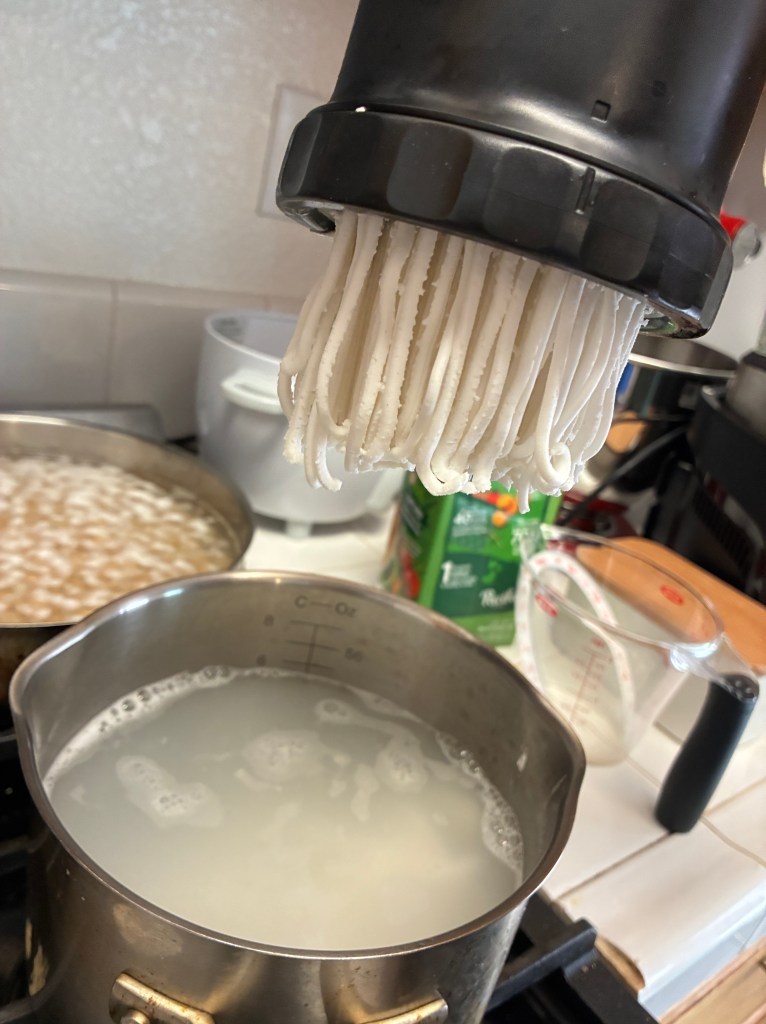
- Here comes the fun and hard part. If you can change the thickness of your ricer, pick the one that you want (I forgot). Put one of the balls into the potato ricer. Push it out all of the way and cut the end of it off. The strands clumped together less for thicker noodles (I accidentally made udon). And, the strands will clump together more for thinner noodles. I have not figured out a way to help the noodles not stick together.
Results:
Honestly, it was ugly. Some may even call it hideous. But, it was more than just edible. It was pretty good and even delicious. The texture was bouncy, actually. I expected it to taste more gloopy, but because we were eating it in a soup, the extra starch was washed away. I think that I was a lot less disappointed than when I made the pearls. Part of it was because Mommy was helping, and the other part of it was that I am learning to be ok with making mistakes. It is my first time making it, and it is alright to not have it come out perfectly. And again, it was ugly, but delicious.
Sadly, it doesn’t save you any money to make it yourself. A bag of rice flour costs $1.50. 4 packs of instant udon is about $4. I would say that you have to buy two bags of flour to be able to make the same amount of udon.
I will continue on trying to make it better because it is actually pretty straightforward. And, I can allow myself to continue making mistakes and getting better. I don’t think that even your grandmother ever made her own noodles. Do you think she would be proud of me?
TO DO:
I need to look up how to keep the noodles from sticking together. Is there a way to press or cut it where it doesn’t stick?


 The Food That Made Me
Leave a comment